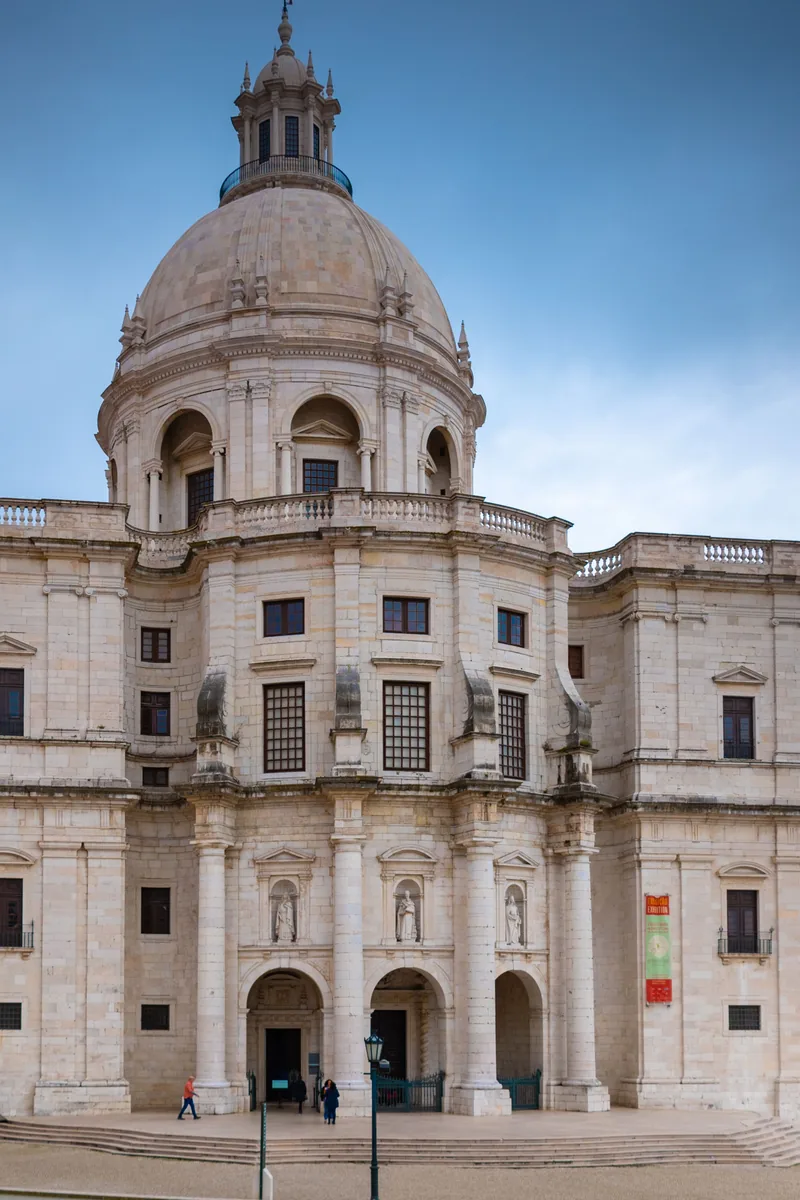
Portugal's poets, its fado queen, and its greatest footballer rest here
The Panteão Nacional is Lisbon's National Pantheon — the seventeenth-century domed church of Santa Engrácia in Alfama, where Amália Rodrigues, Eusébio, Almeida Garrett and the cenotaph of Luís de Camões share a single polychrome-marble interior. Climb the dome for a 360° view over the Tagus, the Alfama rooftops and the 25 de Abril Bridge — one of the great hidden panoramas of Lisbon.
Choose your visit date- 360° dome view Rooftop terrace over Alfama, the Tagus and the 25 de Abril Bridge
- 1682–1966 Took 284 years to finish — origin of the Portuguese idiom 'obras de Santa Engrácia'
- Amália rests here Interments include Amália Rodrigues, Eusébio, Almeida Garrett, Sophia de Mello Breyner
- Alfama address Campo de Santa Clara — five minutes from the Tram 28 line
Tickets and tours for Panteão Nacional
Compare the best-rated ways to visit, check live availability and book in a few taps.
- Top pick
Lisbon: National Pantheon E-Ticket & Audio City Tour
An entry e-ticket to the National Pantheon with an app audio guide in several languages, and free cancellation.
From US$16Check availability ↗ Lisbon: National Pantheon Entry Ticket
The official timed skip-the-line entry ticket to the Pantheon, its tombs and the dome terrace; this ticket cannot be refunded.
From US$11Check availability ↗National Pantheon & São Vicente de Fora Lisbon Private Tour
A private guided visit of the National Pantheon and the nearby São Vicente de Fora monastery, with skip-the-line entry.
From US$218Check availability ↗
More things to do nearby
About Panteão Nacional
The Panteão Nacional occupies the seventeenth-century church of Santa Engrácia in the Alfama district of Lisbon, on the Campo de Santa Clara above the Tagus. Begun in 1682 to the design of João Antunes — Portugal's first major baroque architect — the building is laid out as a Greek cross under a vast central dome, faced inside and out with the coloured Portuguese marbles that became a signature of the late seventeenth-century Lisbon school. The original Santa Engrácia parish church on the site had been destroyed by a windstorm in 1681, and the rebuild was conceived from the outset as one of the most ambitious baroque interiors in Portugal.
Construction took an extraordinarily long time. The dome remained unfinished through the eighteenth, nineteenth and most of the twentieth century, and the church was only formally completed in 1966, two hundred and eighty-four years after it was begun. The Portuguese language preserves the memory of this delay in the idiom 'obras de Santa Engrácia' — 'works of Santa Engrácia' — used to describe any project that drags on indefinitely. The decree converting Santa Engrácia into the National Pantheon was signed in 1916, and the first interments and cenotaphs followed in the years immediately after. The building has served as Portugal's official memorial church ever since.
The interments and cenotaphs are the heart of the visit. The empty memorial — a cenotaph — of Luís de Camões, Portugal's epic poet, stands inside the dome despite the fact that his actual remains were lost centuries ago. Real burials include the writers Almeida Garrett and Aquilino Ribeiro; the poet Sophia de Mello Breyner Andresen; Manuel de Arriaga, the first elected President of the Portuguese Republic; the resistance leader Humberto Delgado; the fado singer Amália Rodrigues, interred in 2001 in a ceremony watched by much of the country; and the footballer Eusébio da Silva Ferreira, transferred to the Pantheon in 2015 after his death the previous year.
Climb to the upper galleries and out onto the rooftop terrace and the building turns into one of the great Lisbon viewpoints. The 360° panorama from the base of the dome takes in the red-tile rooftops of Alfama, the Tagus estuary, the cruise port, the Castle of São Jorge across the valley, the 25 de Abril Bridge, and the Cristo Rei statue on the far bank. The dome stands at roughly eighty metres at its peak — modest by European cathedral standards, but high enough above the Alfama hillside to command a view that few visitors expect from a church interior.
Practical information
- Address
- Campo de Santa Clara, 1100-471 Lisboa, Portugal
- Hours
- Tuesday to Sunday 10:00–17:00 (October to March) / 10:00–18:00 (April to September). Closed Mondays. Annual closures: 1 January, Easter Sunday, 1 May, 13 June (Santo António — Lisbon's patron saint), 24 and 25 December.
- Getting there
- Tram 28 to Voz do Operário (5-minute walk). Train to Santa Apolónia (10-minute uphill walk through Alfama). Bus 712 or 734 to Voz do Operário. On foot from the Castle of São Jorge: 15 minutes downhill through Alfama. No on-site parking — Alfama is restricted-access.
- Time needed
- 60 to 90 minutes for the standard route: ground-floor nave, cenotaphs and tombs, upper gallery, rooftop terrace.
- What to wear
- Comfortable shoes — the climb to the dome involves several flights of stairs. The building remains a memorial space; modest dress is appreciated.
- Accessibility
- Ground floor and main nave are wheelchair accessible. The upper galleries and rooftop terrace are reached by stairs only and are not accessible.
Plan your visit
Practical guides written by our travel team
How to Get to the Panteão Nacional from Central Lisbon
Getting to the Panteão Nacional in Lisbon: Tram 28 from Chiado and Baixa, train to Santa Apolónia, taxi or Uber
Panteão Nacional and Alfama in a Single Day
A full-day Alfama itinerary combining the Pantheon with the Castle of São Jorge, the Feira da Ladra flea market, the miradouros, and an evening of fado — written by the team that books skip-the-line tickets.
Who Is Buried at the Panteão Nacional
A complete guide to the interments and cenotaphs at Portugal's National Pantheon — from the empty memorial of Luís de Camões to the modern tombs of Amália Rodrigues and Eusébio.
Frequently asked
What are the opening hours?
Tuesday to Sunday, 10:00 to 17:00 from October through March, and 10:00 to 18:00 from April through September. Closed every Monday — this is the most common planning mistake international visitors make. Also closed on 1 January, Easter Sunday, 1 May, 13 June (Santo António, Lisbon's patron saint feast), and 24 and 25 December. Last entry is normally thirty minutes before the published closing time, and the rooftop terrace tends to close fifteen minutes before the rest of the building so the dome stairs can clear.
Where exactly is the Pantheon?
On the Campo de Santa Clara in the upper Alfama district of central Lisbon, ten minutes uphill on foot from the Santa Apolónia train station or a short walk from the Tram 28 stop at Voz do Operário. The address is Campo de Santa Clara, 1100-471 Lisboa. The building is the large white-domed church on the north side of the square. Look for the dome from anywhere in lower Alfama — it is the most prominent landmark in the upper neighbourhood and easy to navigate to on foot.
Who is buried at the National Pantheon?
Real interments include the writers Almeida Garrett and Aquilino Ribeiro; the poet Sophia de Mello Breyner Andresen; Manuel de Arriaga, the first elected President of the Republic; the resistance leader Humberto Delgado; the fado singer Amália Rodrigues, interred in 2001; and the footballer Eusébio, transferred here in 2015. The cenotaph (empty memorial) of Luís de Camões, Portugal's epic poet, also stands inside the dome — his actual remains were lost centuries ago. Several other writers, presidents and cultural figures are honoured with smaller cenotaphs around the nave.
Can I see the view from the dome?
Yes — the climb to the upper galleries and out onto the rooftop terrace at the base of the dome is the highlight of most visits. The 360° panorama takes in the Alfama rooftops, the Tagus estuary, the cruise port, the Castle of São Jorge across the valley, the 25 de Abril Bridge, and the Cristo Rei statue on the south bank. The climb involves several flights of stairs and is not wheelchair accessible. The rooftop normally closes fifteen minutes before the rest of the building, so plan accordingly.
Why did it take so long to finish?
Construction began in 1682 after the previous church on the site was destroyed by a windstorm in 1681. The dome was the most ambitious element and was repeatedly delayed by funding shortages, political turmoil, the 1755 Lisbon earthquake, and the dissolution of the religious orders in 1834. The building was only formally completed in 1966 — two hundred and eighty-four years after it was begun. The Portuguese idiom 'obras de Santa Engrácia' — the works of Santa Engrácia — has been used since the eighteenth century to describe any project that drags on indefinitely.
When did Santa Engrácia become the National Pantheon?
By decree of the Portuguese Republic in 1916. The First Republic had been established in 1910 after the fall of the monarchy, and the new regime sought a single monumental setting in which to honour figures of national cultural and political importance. Santa Engrácia, then still structurally incomplete, was chosen for its scale, its central Lisbon location, and its relatively recent baroque architecture, which was felt to be more suitable for a civic memorial than the medieval churches of the lower city. The first interments and cenotaphs followed in the late 1910s and 1920s.
How long does a visit take?
60 to 90 minutes for the standard route: the polychrome-marble nave on the ground floor, the cenotaphs and presidential tombs, the upper gallery walk, and the climb to the rooftop terrace at the base of the dome. Visitors with a specific interest in Portuguese cultural history — particularly the lives of Amália Rodrigues, Eusébio, or the writers interred here — typically spend longer at the individual tombs. Combine with a coffee on the Campo de Santa Clara and a stroll through Alfama for a comfortable half-day.
How do I get there?
The most atmospheric option is Tram 28, the iconic yellow tram that climbs through Alfama — get off at Voz do Operário, then walk five minutes east. Alternatively, take the train to Santa Apolónia (the eastern Lisbon terminus) and walk ten minutes uphill through Alfama; or take bus 712 or 734 to Voz do Operário. On foot from the Castle of São Jorge, the walk down through Alfama takes about fifteen minutes. There is no on-site parking — the Alfama streets are restricted-access and narrow.
What is the Feira da Ladra?
Lisbon's traditional flea market — the name translates roughly as 'Thieves' Fair' — held every Tuesday and Saturday morning on the Campo de Santa Clara immediately outside the Pantheon. Stalls sell everything from antiques and vintage clothing to Portuguese azulejo tiles, old books, vinyl records, and bric-a-brac. It is one of the oldest continuous markets in Lisbon and runs from around 9am to about 6pm. Combining a Pantheon visit with a wander through the Feira on a Saturday morning is one of the classic Alfama half-days, though the area gets crowded after 11am.
Is there a dress code?
The Panteão Nacional is no longer a consecrated church in active liturgical use — it is a civic memorial — but it remains a respectful memorial space, and modest dress is appreciated. There is no formal enforcement at the door. Shoulders covered and shorts that reach the knee is the working standard. Comfortable closed-toe walking shoes are more important than wardrobe formality, because the climb to the rooftop terrace involves several flights of stairs on smooth marble that can be slippery.
Can I take photographs?
Yes, throughout the building including the upper galleries and rooftop terrace, without flash. Tripods, selfie sticks, and external lighting equipment require an advance permit from the operator and are not normally allowed during standard visitor hours. The rooftop terrace at the base of the dome is one of the best photographic vantage points in central Lisbon, particularly in the early morning when the light catches the Alfama rooftops, and again in the late afternoon when the Tagus is backlit and the 25 de Abril Bridge stands in clean profile against the southern sky.
Is there food on site?
There is no café or restaurant inside the Pantheon. The Campo de Santa Clara immediately outside has several small cafés and tascas serving coffee, pastries and simple Portuguese lunches; the wider Alfama neighbourhood has dozens of restaurants within ten minutes' walk, ranging from traditional fado houses to modern petisco bars. On market days (Tuesdays and Saturdays) the food stalls of the Feira da Ladra serve grilled sausage, bifana sandwiches, and similar street food. We can recommend specific Alfama restaurants on request when you book.
What is the Panteão Nacional?
The Panteão Nacional, or National Pantheon of Portugal, is the country's official memorial building, where the Portuguese state honours figures of national cultural and political importance through burial or commemorative cenotaph. It occupies the seventeenth-century church of Santa Engrácia in the Alfama district of Lisbon, set high on the Campo de Santa Clara above the River Tagus. Designed by the architect João Antunes as a Greek-cross plan beneath a vast central dome, and faced inside with brightly coloured Portuguese marbles, it counts among the most ambitious baroque interiors in the country. Begun in 1682, it was only formally completed in 1966 — a 284-year delay that gave Portuguese the idiom "obras de Santa Engrácia" for any project that drags on endlessly. Among those honoured here are the fado singer Amália Rodrigues, the footballer Eusébio, the writer Almeida Garrett, and a cenotaph to the poet Luís de Camões.
How do I get to the Panteão Nacional?
The Panteão Nacional stands on the Campo de Santa Clara in the upper Alfama district of central Lisbon, and is reached most memorably by the historic Tram 28E, the yellow tram that climbs through Alfama and Graça. Leave it near the Voz do Operário stop and walk a few minutes east towards the white dome, which is visible along the way. Bus 734 stops closer still, at Campo de Santa Clara immediately outside the entrance. Alternatively, take a train to Santa Apolónia, the eastern terminus on the Tagus waterfront, and climb roughly ten minutes uphill through the narrow Alfama streets. On foot from the Castle of São Jorge, the walk downhill takes about fifteen minutes. There is no on-site parking — the Alfama lanes are restricted-access and too narrow for visitor cars — so walking, the tram, or a taxi dropping at the square are the practical options.
How does booking work on this site?
This site is an independent visitor guide to Panteão Nacional. When you choose a ticket or tour, you book it directly with GetYourGuide, which takes the payment, issues the ticket and handles any changes or cancellations. We may earn a commission when you book, at no extra cost to you.